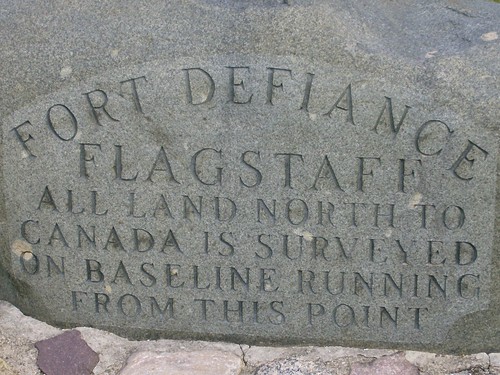
 Today I was engaged in a conservation about property lines and state boundaries in NW Ohio. To stimulate conservation I related a little know fact that all property and boundary lines north of Defiance Ohio to Canada are measured off the baseline of the flagstaff located at Fort Defiance. Fort Defiance was built by General Anthony Wayne in August 1794 at the confluence of the Auglaize and Maumee Rivers and played an important role securing lands for a growing nation. Two hundred years later actions taken by our ancestors are affecting everyday life from state boundries, county lines, townships, personal property in NW Ohio to the taxes we pay all because of a flagstaff located at Fort Defiance, Defiance Ohio.
Monday, October 8, 2007
Fort Defiance....Little Known Fact!
Today I was engaged in a conservation about property lines and state boundaries in NW Ohio. To stimulate conservation I related a little know fact that all property and boundary lines north of Defiance Ohio to Canada are measured off the baseline of the flagstaff located at Fort Defiance. Fort Defiance was built by General Anthony Wayne in August 1794 at the confluence of the Auglaize and Maumee Rivers and played an important role securing lands for a growing nation. Two hundred years later actions taken by our ancestors are affecting everyday life from state boundries, county lines, townships, personal property in NW Ohio to the taxes we pay all because of a flagstaff located at Fort Defiance, Defiance Ohio.

Sunday, October 7, 2007
PhotoHunt #78: Curvey
 Among the most beautiful and enigmatic of all prehistoric Indian remains is a group of objects which are called slate artifacts or merely slate. Slate artifacts such as the pendants and gorgets have long been the most popular of all prehistoric Indian relics among collectors. The actual function of these slate pendants is not known and only through archaeological investigation can their true purpose be revealed. The three slate pieces pictured above (left to right) Keyhole pendant, Logan County, Ohio; Keyhole pendant, Ashland County, Ohio; Pentagonal pendant, Wood County, Ohio., have convex ends and concave sides making then the perfect fit for this weeks PhotoHunt: curvey
Saturday, October 6, 2007
The Gadsden Purchase
 While reviewing the industrial sites that my employer monitors in Mexico a friend mentioned the Gadsden Purchase which I had not heard of before. Searching the web for information I found that in 1854, the United States purchased a strip of territory (approximately 30,000 square miles) from Mexico in what is now southwestern New Mexico and southern Arizona. The purchase price was $10 million, which at the time was greatly overpriced for what was essentially desert lands, because this price reflected the public sentiments at the time. Many Americans considered the price of the Gadsden Purchase as "conscience money" or additional compensation for the earlier purchase of vast tracts of land under the 1848 Guadalupe-Hidalgo Treaty (American-Mexicam War of 1848). This is interesting because the acquisition of land in this purchase defined the present boundaries of the continental United States.
Friday, October 5, 2007
Cumberland Gap
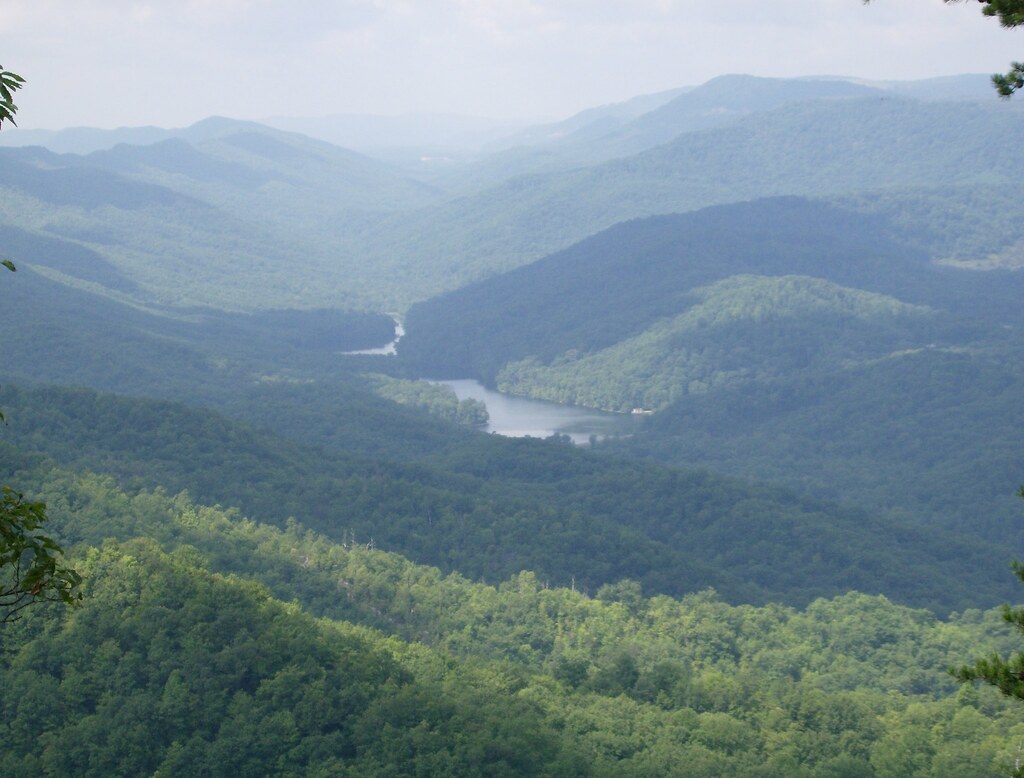 Several months ago I stood on the same pinnacle as Daniel Boone and viewed the same landscape, then a wilderness now called Kentucky. It was an awesome view and I can only imagine what Daniel Boone viewed and thought in 1775 when it was a wilderness. I wonder then if he knew the high price he and other settlers would pay with their lives trying to forge a living and expanding the young nation westward.
Thursday, October 4, 2007
U.S. Army College Plan
The United States Army plans to offer accredited college credit hours for its training programs with enough offerings that a soldier could retire with a bachelor's degree. The college of the American Soldier program is a recruitment tool as the Army seeks to expand its force. The Army is working with colleges to get its program accredited and hopes to have it running in February 08.
Under the plan, every recruit in basic training will have the option of obtaining a technical certificate in a skill such as welding or a potential 17 hours of college credit in leadership, first aid, and other areas. The idea being by the time your a staff sergent, somewhere between 6 and 10 years in the Army you're going to have your associate's degree. Those who continue in the service and retire as sergent or sergent major could earn a bachelor's degree. Along with the current educational incentives this will be the most educated Army in the world and a outstanding way to help service personal achieve goals that will last a life time.
Under the plan, every recruit in basic training will have the option of obtaining a technical certificate in a skill such as welding or a potential 17 hours of college credit in leadership, first aid, and other areas. The idea being by the time your a staff sergent, somewhere between 6 and 10 years in the Army you're going to have your associate's degree. Those who continue in the service and retire as sergent or sergent major could earn a bachelor's degree. Along with the current educational incentives this will be the most educated Army in the world and a outstanding way to help service personal achieve goals that will last a life time.
Wednesday, October 3, 2007
Presidental Families: George Washington
Fostering was the common practice in the colonial era, of taking in children of relatives who could not care for their offspring, or children who had been left orphans. Because of the unusually high birth and death rates of the period, many children were left with a single parent or no parent at all. In such cases relatives took in the children and raised them as their own, but without a formal adoption process. This custom was embraced in the George Washington and John Adams family.
Show me the Money! The real one....
 Well it looks like the United States Mint has changed yet another bill, this time it's the $5 Bill. The United States Mint added, moved and deleted some features of the $5 Bill to make it harder to counterfeit. What they added was the color "purple" and moved the security strip from one location to another. What they removed was the ever popular oval frame that surrounded the President Lincoln and the Lincoln Memorial. I was a bit shocked but not surprised to find out that the 5 dollar bills were bleached and then were reprinted as fake 100 dollar bills. Apparently the features of the $5 and $100 were similar so the counterfeiters didn't have much trouble swapping the two. Well let's see how long it will be until the next face lift.
Subscribe to:
Comments (Atom)